
The Botanical Education Trust made awards this year to four recipients from the eleven applications received. It was a challenging task for the trustees to select which projects would best serve the conservation of our indigenous flora. However, they were ably guided by the three botanist trustees, being Prof Braam van Wyk, Dr Neil Crouch and Prof Glynis Goodman. Prof Goodman has only recently joined as a trustee, after the retirement of Dr Hugh Glen who was a founder member of the Trust 16 years ago.
Because all donations received by the Trust are invested permanently, the awards were funded only by income from the investments during the last year. The Trustees are grateful to all the donors over the years who have made these grants possible.
Three of the grant recipients are from Wits University and it is very positive that two are promising young botanists.
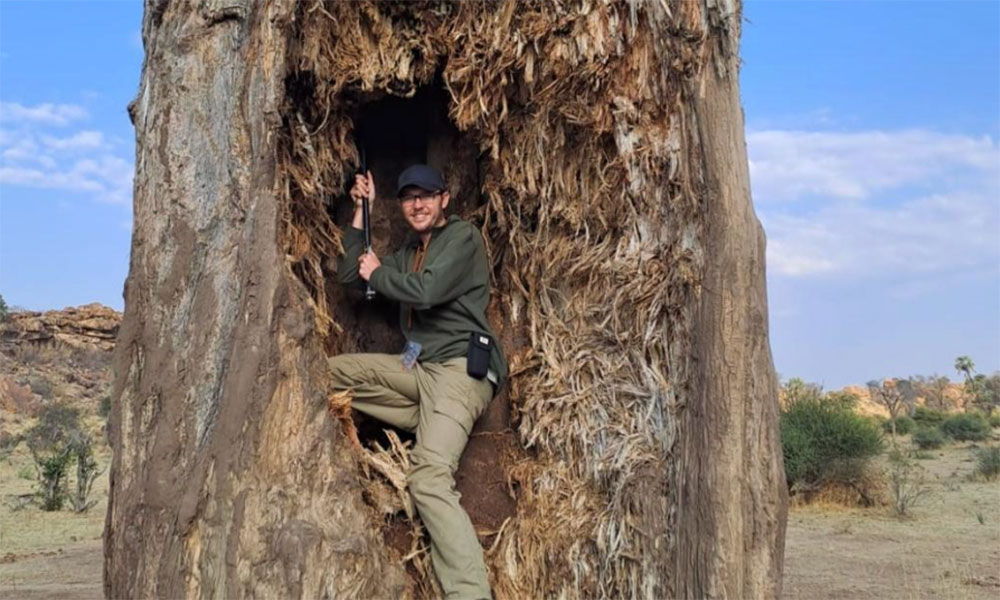
One is Liam Taylor who is investigating the role of baobab trees in supporting entire ecosystems. This is his second award from the Botanical Education Trust. So far his study, in Mapungubwe National Park, has shown that baobab trees provide nesting habitats (particularly large cavities) that are non-existent in the surrounding vegetation. Thus they provide a unique and irreplaceable habitat for supporting biodiversity. He is now expanding his project to the Kruger National Park where he suspects that baobabs may have even greater keystone significance. The very large elephant populations in our national parks are causing a huge loss of large trees such as baobabs. As this is an issue that needs urgent management response, it is important to help further justify that this tree species needs protection.

The second young botanist is Saness Moodley. Having recently completed her MSc degree, she is studying the pollination ecology of mountain grassland. Grassland is the most threatened biome in our country and little is known about the interaction of the community of plants and animals that make up this habitat, especially in mountain regions. Saness will investigate how pollinators influence community structure through their interactions with these plants. Understanding the reasons for these differences aims to contribute to improved conservation management of these species as well as, more broadly, of the grassland habitat.

will investigate the pollination ecology of mountain grassland
Like Liam Taylor, Willem Froneman is also receiving a second award from the Botanical Education Trust. His grant is for his project entitled Barleria in South Africa: Waterwise, Sun-loving, Beautiful and Prickly. Of the approximately 330 species of Barleria worldwide, 50 are in South Africa and at least a further 12 are still being described. This project will culminate in a book which will include an up-to-date revision of the genus, detailed descriptions, distribution maps and a painting of every species to facilitate identification. It will also cover horticultural aspects and deal with propagation methods of this charismatic group of plants.
The last grant is to the Ingcungcu Sunbird Restoration Project which aims to heal the relationship between plants, birds and people on the Cape Flats. Planting locally indigenous stepping-stone gardens is creating a sunbird migration corridor across the Cape Flats, while at the same time establishing learning spaces for children. Youth volunteers, who study or are involved in conservation, botany and ornithology accompany learners on field trips. This provides learners with focused forms of engagement, as volunteers act as mentors and role models. The next generations will only preserve what little remains of our natural vegetation if they come to know and appreciate it.

Although the Empangeni High School was not successful with their grant application, the Trust nevertheless donated some gardening and plant books to their library.

Please do not hesitate to contact me for further information on the Botanical Education Trust by e-mail at charlesbotha@gmail.com or on 083 7777 078. You are also most welcome to forward this e-mail to anyone else who may be interested.